
The 16 Most Iconic Symbols of Lord Shiva and Their Meanings
Lord Shiva, or Mahadeva, is perhaps the most complex deity in Hinduism. “Shiva” means The Auspicious One. He is also known as the Great (Rudra), the Lord of Dance (Nataraja), and the Lord of the Universe (Vishwanatha). He is the Destroyer and the Transformer—infinite, transcendent, unchanging, formless, and without beginning or end.
- Brahman: The Absolute Reality
- Shiva in the Three Realms of Brahman
- The 16 Symbols of Lord Shiva and Their Meanings
- 1. The Crescent Moon – Ardha-Chandrama
- 2. Body Smeared with Ash
- 3. Matted Hair – Jata
- 4. The Ganges River
- 5. The Third Eye
- 6. Half-Open Eyes
- 7. Serpent Around the Neck
- 8. The Tripundra (Three Lines)
- 9. Tiger Skin
- 10. Rudraksha Necklace
- 11. Damaru (Drum)
- 12. Trishula (Trident)
- 13. Kamandalu
- 14. Kundalas (Earrings)
- 15. Mount Kailash
- 16. Nandi the Bull
Brahman: The Absolute Reality
“SHIVA” means the Auspicious. Humanly speaking, it is impossible to fully explain Shiva, just as it is impossible to fully explain the universe. From a simple human perspective, He is the One from whom Brahman emerges, in whom Brahman dwells, and to whom Brahman returns.
Brahman is not just the Universe, but the origin and cause of the universe. Brahman holds the cosmos together. Lord Shiva is the “Cause of all Causes.” He should not be viewed merely as a “Human-like God”; that is a misconception. The Scriptures refer to Him as both Nirguna Brahman (Formless) and Saguna Brahman (With Form).
Shiva in the Three Realms of Brahman
- Nirguna Realm: In this state, He is formless. The entire universe and all creation lie within the reach of Shiva.
- Saguna Realm: In this state, Shiva is the entire universe and everything within it. He exists in every living being—plants, humans, animals, and all creation. Although all forms emerge from Him, no single form can fully describe Him.
- Nirguna-Saguna Realm: Here, Shiva is worshipped as the Shivalingam. The word Shivalingam comes from the Sanskrit roots Shiva (God) and Lingam (Sign/Symbol). Thus, the Shivalingam is the sign of God within His creation. Shiva’s sign is in everything—from a tree in a seed to a child in a cell. Everything spherical or elliptical is a sign of Lord Shiva. As Shiva is incomprehensible, we worship His sign or the entire Brahman within a Shivalingam.
“NA TASYA PRATIMA ASTI” — Yajur Veda.
(Meaning: “There is no image that can describe Him.”)
It is vital to understand that He is “Formless.” While He is referred to as Shiva (Masculine) or Shivam (Feminine), He exists beyond gender.
The 16 Symbols of Lord Shiva and Their Meanings
Whenever we encounter these divine elements, we immediately think of the Lord. Here are the 16 symbols of Lord Shiva and their profound meanings:
1. The Crescent Moon – Ardha-Chandrama
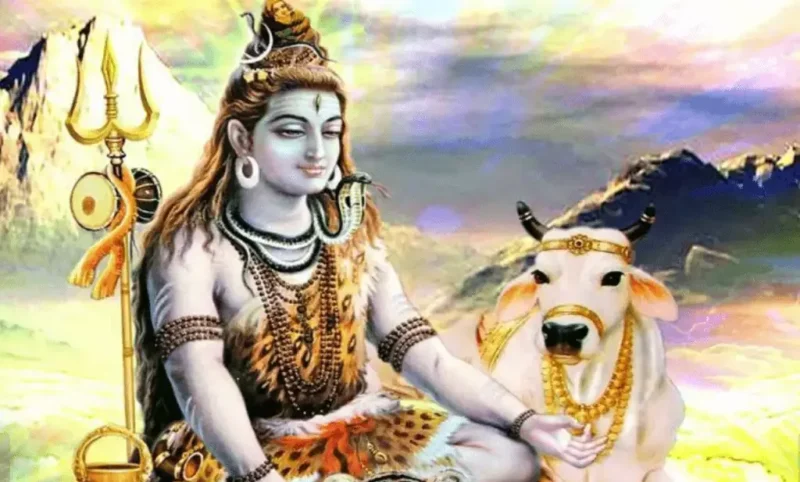
Scientifically and philosophically, the moon on Shiva’s forehead represents control over Time. As the moon is used to calculate days and months, Shiva wearing the moon indicates that He has full control over time and exists beyond its measure—He is Eternal.
2. Body Smeared with Ash
This represents Shiva’s transcendental nature. The ash (often from cremation grounds) symbolizes the ultimate reality: death. Everything material eventually turns to ash. Shiva, as the Destroyer, reminds us that only God transcends the cycle of life and death.
3. Matted Hair – Jata
The matted hair symbolizes mastery over the Wind (Vayu), the breath of all living beings. This represents Shiva as Pashupatinath, the Lord of All Living Creatures.
4. The Ganges River
The Ganges flows from Shiva’s matted hair. As Gangadhara (Bearer of the Ganges), Shiva brings purity, fertility, and peace to the earth. It also symbolizes the sacred Vedic knowledge flowing from generation to generation.
5. The Third Eye
Known as Trinetra, the third eye is the eye of wisdom. It represents the rejection of desire and the ability to see beyond space and time. From a Yogic perspective, it is linked to the Pineal Gland, responsible for mental health and higher consciousness. (Source: Vedicfeed.com)
6. Half-Open Eyes
This indicates that the cycle of the universe is in process. When He fully opens His eyes, a new creation begins; when He closes them, the universe is dissolved. Half-open eyes signify that creation is an eternal, beginningless, and endless cycle.
7. Serpent Around the Neck
The coiled snake represents Time in three stages: past, present, and future. It also signifies the dormant energy within us known as Kundalini Shakti.
8. The Tripundra (Three Lines)
The three lines of ash on His forehead represent the three Gunas: Sattva (Purity), Rajas (Activity), and Tamas (Inertia). Shiva is the one who has transcended these three qualities.
9. Tiger Skin
The tiger represents desire and power (Shakti). Shiva sitting on or wearing tiger skin symbolizes that He has conquered lust and is the ultimate source of energy flowing through the universe.
10. Rudraksha Necklace
Shiva wears a necklace of 108 Rudraksha beads, said to be formed from His own tears. They represent the cosmic laws and the orderly nature of the universe.
11. Damaru (Drum)
The Damaru represents the cosmic sound, AUM. When Shiva vibrates the Damaru, it produces the fundamental sounds (phonemes) of the Sanskrit language—the basis of all grammar and music.
12. Trishula (Trident)
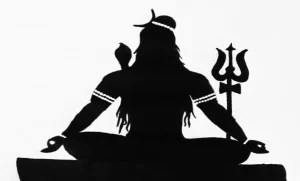
The Trishula represents three fundamental powers: Will (Icchya), Action (Kriya), and Knowledge (Jnana). It shows His power to destroy evil and ignorance.
13. Kamandalu
The water pot made from a dry gourd represents the Yogi aspect of God. To carry the “Amrit” (Nectar of Immortality), one must let go of the material world and ego, just as the gourd is cleaned of its pulp.
14. Kundalas (Earrings)
He wears two earrings: Alakshya (meaning “signless”) and Niranjan (meaning “invisible to the eye”). They represent the dual nature of Shiva and Shakti—the union of masculine and feminine principles.
15. Mount Kailash
Mount Kailash is His abode, symbolizing the center of the universe and the peak of spiritual consciousness. It is a place of absolute silence and meditation.
16. Nandi the Bull
Nandi is Shiva’s vehicle and most devoted disciple. He represents Dharma (Righteousness) and the strength of faith. Nandi waiting patiently before Shiva symbolizes the soul’s longing for the Divine.
Harness the Power of Shiva
Now that you understand His symbols, learn how to invoke His vibration through the Om Namah Shivaya mantra.
READ MANTRA GUIDE →References:
- Vedicfeed – The Meaning and Significance of Lord Shiva’s Symbols
- Shiva Purana – Dharma Samhita & Rudra Samhita.
- Yajur Veda – The Veda of Rituals (Concept of Nirguna Brahman).
- Adi Shankaracharya – Shiva Manasa Puja & Nirvana Shatakam.
- Encyclopedia of Hinduism – Symbolism of Nataraja and Shiva’s Attributes.




Tinggalkan Balasan