
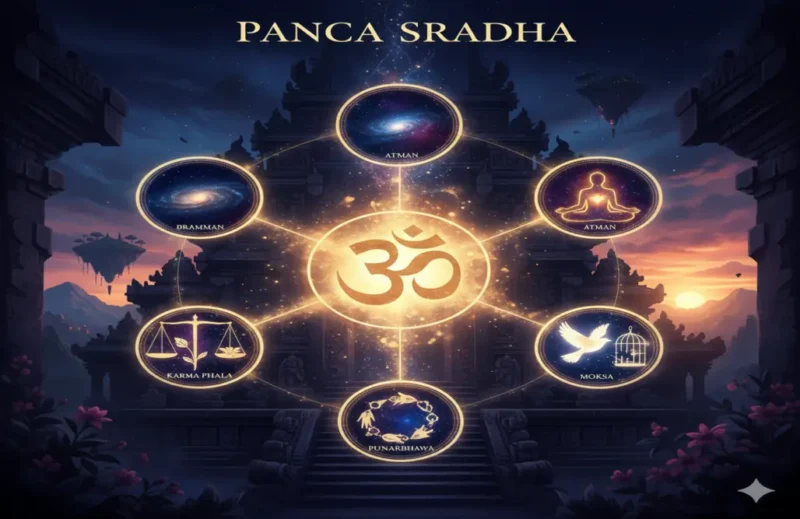
Panca Sradha: The Five Pillars of Hindu Faith
“Diving into the Depths of Dharma, Dissecting Spiritual Logic.”
Introduction: The Foundation of Belief
In the journey of spiritual life, “Sradha” or faith is the compass that guides every step. In the Vedic tradition of Nusantara (Indonesia), this foundation is formulated into five fundamental pillars known as Panca Sradha.
The word “Panca” means five, and “Sradha” means faith or conviction. Without a strong understanding of these five elements, a person’s spiritual practice is like a building without a foundation—fragile and easily swayed by the currents of materialistic thought.
The Five Pillars of Panca Sradha
1. Brahman: Faith in the Existence of God
The first pillar is the conviction that there is a Supreme Reality called Brahman (Ida Sang Hyang Widhi Wasa). He is the source of all that exists (Janmady asya yatah). God is both transcendent (beyond human reach) and immanent (present within every atom).
In the Upanishads, it is stated: “Ekam Sat Vipra Bahudha Vadanti”, which means God is one, but the wise call Him by many names. This faith teaches us that we are never truly alone; there is a supreme witness to every thought and action.
2. Atman: Faith in the Eternal Soul
Atman is the spark of divine light within every living being. While the physical body is temporary and subject to decay, the Atman is eternal, indestructible, and unchanging.
The Bhagavad Gita (2.23) explains: “Nainam chindanti shastrani…” (Weapons cannot cut it, fire cannot burn it). Understanding Atman helps us realize that our true identity is spiritual, not material, fostering a sense of universal brotherhood among all living entities.
3. Karma Phala: Faith in the Law of Cause and Effect
The law of Karma Phala is the universal principle of justice. Every action (Karma) inevitably produces a result (Phala). What we sow today is what we will reap in the future.
This belief encourages practitioners to live ethically and responsibly. It removes the “victim mentality,” as we understand that our current circumstances—whether joyful or challenging—are the mathematical results of our own past choices.
4. Punarbhava: Faith in Rebirth (Samsara)
Punarbhava or Reincarnation is the process of the soul inhabiting a new body after the death of the old one. This cycle continues as long as the soul still has desires and “unpaid” karma.
Rebirth is not a punishment, but a “spiritual classroom.” God gives the soul multiple opportunities to learn, grow, and eventually evolve toward perfection. Each lifetime is a step forward in the long journey of consciousness.
5. Moksha: Faith in Spiritual Liberation
Moksha is the ultimate goal of human life—liberation from the cycle of birth and death (Samsara). It is a state of eternal bliss (Sat-Chit-Ananda) where the Atman unites with Brahman.
Achieving Moksha doesn’t necessarily mean “dying”; one can achieve a state of liberation while still alive, known as Jivanmukti. It is the moment when all material attachments dissolve, and only pure divine love remains.
Conclusion: Panca Sradha in Modern Life
Panca Sradha is not just an ancient theory; it is a practical mental framework. By believing in Karma, we become more patient. By believing in Atman, we become more respectful of others. And by aiming for Moksha, we find a purpose that transcends mundane routines.






Tinggalkan Balasan