
Moksha in the Holy Vedas means freedom from ignorance and suffering
Moksha: The Liberation from Suffering
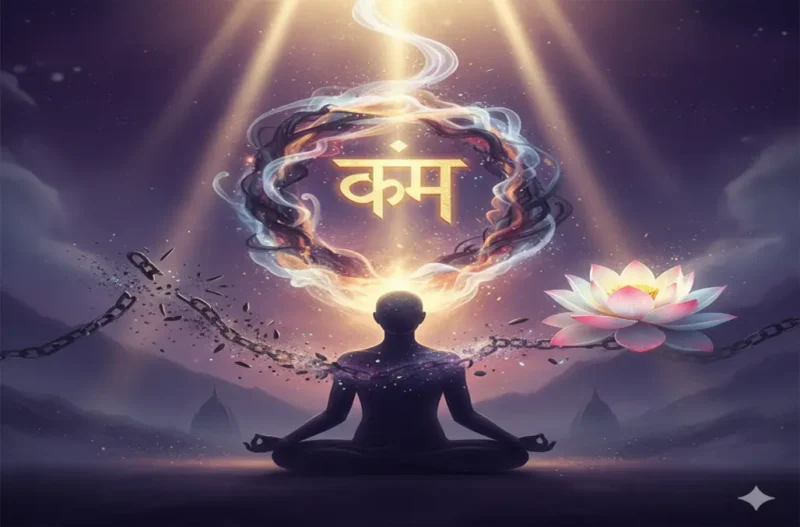
In Hinduism, Moksha (also referred to as mukti) means liberation, release, or freedom from samsara—the continuous cycle of death and rebirth. The concept of moksha in Hinduism signifies liberation from ignorance (avidya) and grief, the realization of the true self, and absolute union with the Divine. Within the Hindu tradition, moksha is the central concept and the ultimate goal to be achieved during one’s lifetime.
The concept of Moksha is intrinsically linked to the cycle of samsara. Human life is bound to an repetitive process of rebirth. This recurring cycle of birth and life is viewed as a state of inherent suffering, making union with Brahman/the Divine (Moksha) the primary objective of every soul (jiwatman). Unlike several other religious beliefs, the ultimate goal in Hinduism is neither a temporary heaven nor a hell, but a permanent union with Brahman. This state implies that the soul has been entirely liberated from the earthly cycles of reincarnation.
By breaking free from the cycle of Samsara, the suffering embedded within that cycle reaches its absolute end. The ancient sages and Brahmans observed that individuals vary significantly in their quality of life—some live virtuously while others remain bound by sin. This led to deep contemplations on how the balance of an individual’s punya (merit, righteous deeds) or papa (demerit, sin) influences their subsequent journey of consciousness.
This inquiry shaped the understanding of the afterlife, where a soul resides temporarily in heavenly or hellish realms according to its deeds, before eventually returning to earth to be reborn in an endless loop. This notion of rebirth eventually evolved into the mature law of karma—where the exact matrix of one’s accumulated actions determines the form and circumstances of the next incarnation.
Alongside this framework of samsara, the concept of moksha was introduced as an absolute state that emancipates an individual from the laws of causality. According to ancient Hindu literature, this release is attained through self-realization (jnana) and a profound awareness of the unity between the individual soul and the Supreme Consciousness.
The Concept of Moksha in Panca Sraddha
Hindu philosophy firmly places Moksha as the crowning element of the five pillars of faith, known as the Panca Sraddha:
- Brahman – Belief and absolute faith in the Supreme God Substantia.
- Atma – Belief that within every living being lies a divine spark (jiwatman) originating from Brahman.
- Karma Phala – Belief in the absolute law of cause and effect. A person’s actions bind the soul to reincarnation or, conversely, pave the way for its liberation.
- Samsara – Belief in the reality of rebirth, re-manifestation, or reincarnation.
- Moksha – Ultimate liberation from the cycle of rebirth and absolute dissolution into the Almighty.
Moksha marks the definitive end of this entire chain of reincarnation, where an individual’s consciousness transcends all worldly ignorance and attachments to achieve supreme bliss (sat-cit-ananda). In various schools of Hindu philosophy, moksha can also be attained while still inhabiting the physical body, a state known as self-realization in life (jivanmukti).
The Concept of Moksha in Catur Purusartha
Within Hindu ethics, Moksha represents the ultimate tier of the four ideal goals of human life, collectively called the Catur Purusartha. The Catur Purusartha consists of:
- Dharma – Living a life aligned with righteousness, duty, and moral order.
- Artha – Acquiring the material means for wealth, security, and prosperity through honest paths.
- Kama – Appreciating aesthetic pleasures, legitimate desires, and love.
- Moksha – Complete detachment from material bonds and worldly temporalities.
The journey of human life progresses in gradual stages. An individual is expected to fulfill the first three goals (Dharma, Artha, Kama) in a balanced manner, before gradually loosening their grip on material wealth and sensory desires, ultimately focusing their full consciousness toward attaining Moksha.
The Concept of Moksha in the Bhagavad Gita
The Bhagavad Gita outlines practical pathways to achieve these life goals through actions driven purely by sacred duty without personal attachment, a concept known as Nishkama Karma. This is the core message of the scripture: a dynamic equilibrium between performing one’s duties in the world and renouncing the fruits of those actions to the Divine serves as the primary engine for ultimate freedom.
Bhagavad Gita 18.65
man-manā bhava mad-bhakto mad-yājī māṁ namaskuru
mām evaiṣyasi satyaṁ te pratijāne priyo’si me
“Fix your mind on Me, be devoted to Me, offer sacrifice to Me, bow down to Me. In this way, you shall surely reach Me. This is My true promise to you, for you are deeply dear to Me.”
Sri Krishna reiterates these prominent features of the Gita’s philosophy for the benefit of Arjuna, and through their dialogue, all of humanity can reap its wisdom. The Divine establishes four inner prerequisites for a seeker of enlightenment to ensure they do not underestimate His decree:
- Anchoring the mind solely on the Divine and constantly remembering Him.
- Viewing Him as the ultimate and single source of refuge.
- Aligning one’s identity with Him through the path of selfless action.
- Devoting oneself to Him in an attitude of reverence and the sacrifice of the ego.
Bhagavad Gita 18.66
sarva-dharmān parityajya mām ekaṁ śaraṇaṁ vraja
ahaṁ tvāṁ sarva-pāpebhyo mokṣayiṣyāmi mā śucaḥ
“Abandon all varieties of Dharma (surrendering all duties to the Indweller of every being, which encompasses the body, mind, and intellect), take refuge in Me alone; I shall liberate you from all sins, do not grieve.”
This particular verse is considered one of the most sublime and extensively debated slokas in the entire Bhagavad Gita. Great philosophers, translators, and commentators have put forth deep insights regarding this verse, each maintaining their realized spiritual perspectives.
In this verse, the Divine instructs us to accomplish three internal realignments within our inner personality: (1) Transcending all worldly dependencies and conceptual frameworks (Dharma) through deep meditation; (2) Surrendering entirely to His shelter alone; and while in that meditative state, (3) Ceasing all anxieties and batin worries. In return, He promises absolute liberation from all karmic bondage. Being pure of sin is an absolute prerequisite to merge back into Him and completely shatter the chains of samsara.
The Concept of Moksha in the Yoga Sutras
The system of Ashtanga Yoga (the Eightfold Path of Yoga) compiled by Sage Patanjali in the Yoga Sutras serves as a highly systematic and practical roadmap to realize moksha. In broader Hindu theology, this path of release can be approached through four primary paths (Catur Marga Yoga): Jnana Yoga (the path of knowledge), Bhakti Yoga (the path of devotion/love), Karma Yoga (the path of selfless action), and Raja Yoga (the path of meditation/mind control).
Sources: Bhagavad Gita Chapter 18 | Yogapedia | eSamskriti





Tinggalkan Balasan