
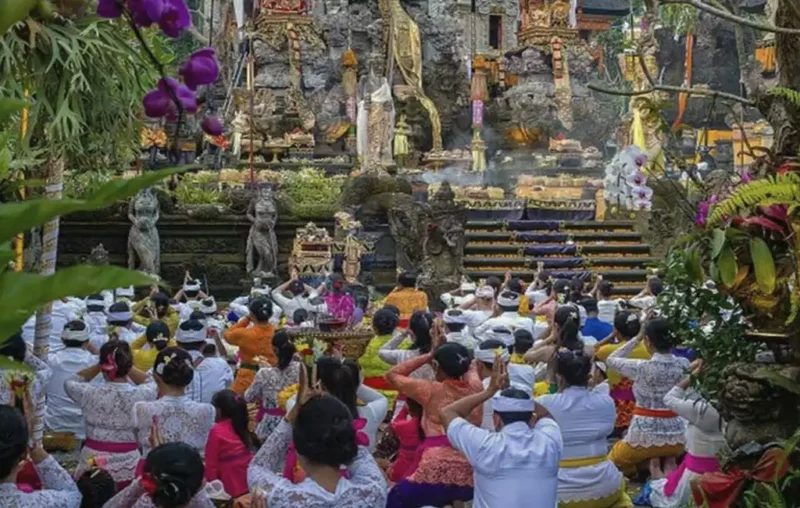
Puja Trisandhya: Meaning, Significance, and Purpose
“Diving into the Depths of Dharma, Dissecting Spiritual Logic.”
Understanding Puja Trisandhya
Etymologically, Trisandhya is derived from the word “Tri,” meaning three, and “Sandhya,” meaning connection or meeting point of time. As the name suggests, this sacred mantra is chanted during three crucial transition periods of the day: at dawn (Pratasandhya), exactly at noon (Madhyasandhya), and at dusk (Sandhyakala).
The Purpose of Performing Puja Trisandhya
The practice of Puja Trisandhya aims to worship the majesty of Ida Sang Hyang Widhi Wasa (God Almighty) in His manifestation as Parama Shiva, to seek mental clarity through the Gayatri Mantra, and as a means of self-purification (atmaprasangsa) for any mistakes made in thought, word, and deed. By understanding the deep meaning of each verse, practitioners are expected to achieve inner peace and life harmony in accordance with the teachings of Dharma.
The Scriptural Sources of Puja Trisandhya
This mantra is a compilation of various Vedic sacred scriptures, ranging from the Rig Veda to the Upanishads. Here are the details of the original sources:
- Verse I: Gayatri Mantram
- Source: Rig Veda (Mandala 3.62.10).
- Context: Known as the Savitri Mantra, dedicated to God as the stimulator of intelligence (Savitar).
- Verse II: Narayana Mantram
- Source: Narayana Upanishad (Verse 1).
- Context: Explains the omnipotence of God as Narayana, the source of all existence.
- Verse III: Shiva Mantram
- Source: Shiva Tattwa / Shiva Stotram collection.
- Context: Worshipping Shiva as Mahadewa, Isvara, and Rudra.
- Verse IV: Ksama Mantram (Forgiveness)
- Source: Shiva Stawa.
- Context: A prayer for forgiveness for any shortcomings in performing worship.
- Verse V: Sarwa Papa Mantram
- Source: Prarthana / Stotra collection.
- Context: A humble admission of human flaws and a plea for total purification.
- Verse VI: Ksama Prarthana
- Source: Concluding Sloka / Stotra collection.
- Context: A closing prayer to seek forgiveness for errors committed through the “Tri Kaya” (thoughts, words, and actions).
Preparation Before Puja Trisandhya
Before reciting the main mantra, it is highly recommended to perform self-purification through the following steps:
- Asana (Posture):
- “Om prasada sthiti sarira siwa suci nirmala ya namah swaha.”
- Meaning: Oh God, in the form of Shiva, I bow to You in a calm, pure, and unstained sitting posture.
- Pranayama (Breath Control):
- “Om Ang Namah (Inhale), Om Ung Namah (Hold), Om Mang Namah (Exhale).”
- Meaning: Oh God, I worship You as the Creator, Preserver, and Dissolver.
- Karasodhana (Hand Purification):
- “Om Suddhamam swaha (Right hand), Om Ati Suddhamam swaha (Left hand).”
- Meaning: Oh God, purify my hands, purify my hands as pure as possible.
Puja Trisandhya Mantra (Verses 1-6)
Verse I
“Om bhur bhuwah swah, tat sawitur warenyam, bhargo dewasya dhimahi, dhiyo yo nah pracodayat.”
Meaning: Oh God, Creator of the three worlds, You who are most holy and glorious. I meditate upon Your light; may You enlighten my intellect.
Verse II
“Om narayana ewedam sarwam, yad bhutam yac ca bhawyam, niskalanko niranjano nirwikalpo, nirakyatah suddo dewo eko, narayana na dwitiyo’sti kascit.”
Meaning: Oh God, Narayana is all this—what has been and what will be. You are unstained, formless, unchanging, indescribable, pure, and the One. Narayana is the only One; there is no second.
Verse III
“Om twam siwah twam mahadewah, iswarah parameswarah, brahma wisnusca rudrasca, purusah parikirtitah.”
Meaning: Oh God, You are called Shiva, Mahadewa, Iswara, Parameswara, Brahma, Vishnu, Rudra, and Purusha (the Soul of the Universe).
Verse IV
“Om papo’ham papakarmaham, papatma papasambhawah, trahi mam pundarikaksah, sabahya bhyantarah sucih.”
Meaning: Oh God, I am full of sin, my actions are sinful, my soul is sinful, and my birth is sinful. Protect me, Oh God whose eyes are as clear as the lotus; purify me internally and externally.
Verse V
“Om ksamaswa mam mahadewa, sarwaprani hitankara, mam moca sarwa papebhyah, palayaswa sadasiwa.”
Meaning: Oh God, forgive me, Great God who bestows welfare upon all beings. Release me from all sins and protect me, Oh Sadashiva.
Verse VI
“Om ksantawyah kayiko dosah, ksantawyo waciko mama, ksantawyo manaso dosah, tat pramadat ksamaswa mam.”
Meaning: Oh God, forgive the sins of my actions, forgive the sins of my words, and forgive the sins of my thoughts. Forgive me for all my negligences.
“Om Shanti, Shanti, Shanti Om.”
Understanding Cuntaka (Impurity) in Puja Trisandhya
Can Puja Trisandhya still be performed when in a state of physical impurity (Cuntaka)? Here are the guidelines:
- Spiritual Definition: Cuntaka is a temporary state of physical and spiritual impurity (e.g., during menstruation, mourning, or birth).
- Physical Restriction (Wacika): During Cuntaka, one is restricted from entering the main sanctum of a temple and is advised not to recite mantras vocally (Wacika).
- Manasika Puja Solution: The spiritual connection with God should never be broken. The solution is Manasika Puja—performing Puja Trisandhya within the heart and mind without using physical tools like incense or flowers.
Conclusion
Performing Puja Trisandhya regularly is not just a religious obligation but a form of meditation to maintain inner peace amidst the chaos of the world. By understanding the meaning of each verse, our worship becomes more meaningful and sincere.




Tinggalkan Balasan