
Hinduism in Bali vs India: Alike but Not the Same
Hinduism in Bali vs India: Hinduism is one of the oldest religions in the world. Although sharing the same roots in the sacred Vedas, the religious practices of Hinduism in Bali (Indonesia) and India exhibit striking differences.
These distinctions arose from a long process of acculturation. While Hinduism in India evolved within South Asian culture, Hinduism in Bali underwent syncretism with local animist beliefs and the ancestral worship of the Indonesian archipelago.
Here are the 5 primary differences between Balinese Hinduism and Indian Hinduism:
1. Concept of Divinity (Theology)
- Indian Hinduism: Tends to emphasize the worship of many Gods and Goddesses (Polytheism) or focuses on a specific deity (such as Vaishnavism worshipping Vishnu/Krishna, or Shaivism worshipping Shiva). Statues or Murti of deities are central to worship.
- Balinese Hinduism: Adheres to a concept closer to Monotheism. Balinese Hindus worship the One Supreme God called Ida Sang Hyang Widhi Wasa (Acintya). Other deities (Brahma, Vishnu, Shiva) are regarded as manifestations or divine rays of Sang Hyang Widhi. The primary symbol is not a statue, but the Padmasana (an empty throne) in the temple, symbolizing the formless God.
2. Architecture and Places of Worship
- Indian Hinduism: A temple or Mandir in India is usually a closed building with a tall tower (Shikhara). Inside, there is the Garbhagriha (the innermost sanctum) where the deity’s idol is placed.
- Balinese Hinduism: The place of worship is called a Pura. It is designed as an open-air space that blends with nature. Distinctive features include the split gate (Candi Bentar), the Paduraksa gate, and multi-tiered thatched roofs called Meru. A Pura is divided into three zones (Tri Mandala): Nista, Madya, and Utama Mandala.
3. Major Holy Days
- Indian Hinduism: Major national holidays include Diwali (the festival of lights), Holi (the festival of colors), and Navaratri.
- Balinese Hinduism: The most important day is Nyepi (the Day of Silence/Saka New Year), observed with 24 hours of total silence. Additionally, there are Galungan and Kuningan (the victory of Dharma over Adharma), celebrated every 210 days based on the Pawukon calendar. Interestingly, Nyepi is not celebrated on a mass scale in India.
4. Dietary Habits and Taboos
- Indian Hinduism: Many Hindus in India (especially the Brahmin community and those in the North) are strict vegetarians. The cow is revered as a sacred animal (Mother), making beef strictly forbidden.
- Balinese Hinduism: Not all Balinese Hindus are vegetarian. Pork is an essential part of the culinary culture and ceremonies (e.g., Babi Guling). While beef is generally avoided by the Brahmin caste or those undergoing purification, it is not as strictly regulated for the general public as in India. However, the cow is still deeply respected as a helper to farmers.
5. Tradition of Offerings (Sesajen)
- Indian Hinduism: Offerings or Prasad usually consist of sweets, fruits, milk, and flowers, which are later consumed by the devotees after being blessed. Fire rituals (Havan/Yagna) are very dominant.
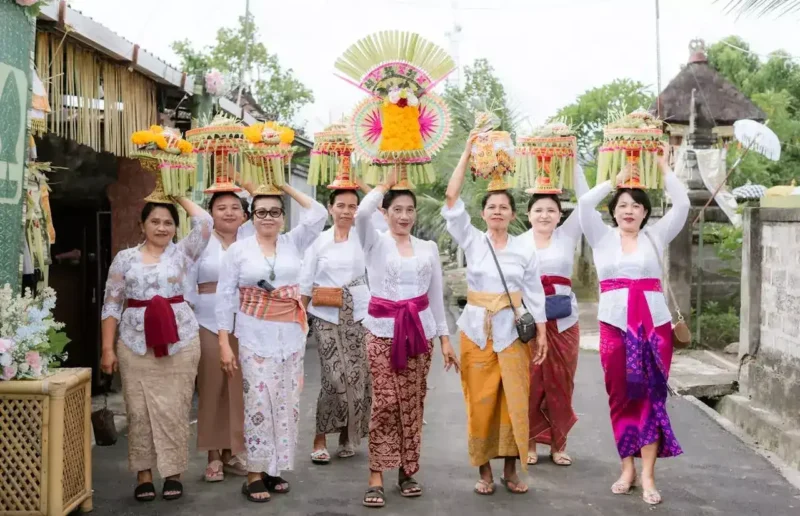
- Balinese Hinduism: Defined by Canang Sari and Banten. These are daily offerings made of young coconut leaves (janur) and flowers, with color philosophies representing the Trimurti. The art of arranging palm leaves and fruits (Gebogan) is highly artistic in Bali. The focus is on maintaining harmony between humans, nature, and God (Tri Hita Karana).
Conclusion Hinduism in Bali vs India
Although differing in practice (“the skin”), Balinese and Indian Hinduism share the same “core” philosophy: belief in Karma Phala (cause and effect), Samsara (rebirth), and the ultimate goal of Moksha (liberation from the cycle of reincarnation).
These differences demonstrate the flexibility of Hindu teachings, which adapt to local culture (Desa, Kala, Patra—Place, Time, and Circumstance) without losing their spiritual essence.
Deepen Your Understanding
The essence of Balinese Hinduism lies in maintaining harmony between God, nature, and humanity.
Learn About Tri Hita Karana →Common Questions About Hinduism in Bali vs India
1. Is Balinese Hinduism different from Indian Hinduism?
Yes, while they share the same Vedic roots, they differ in practice. Balinese Hinduism is a unique blend of Vedic teachings and local Indonesian culture (ancestor worship), whereas Indian Hinduism is deeply influenced by South Asian traditions.
2. Why don’t Balinese Hindus use many statues of Gods like in India?
Balinese Hindus focus on the concept of Sang Hyang Widhi Wasa (The Supreme God) as formless. Instead of statues, they use the Padmasana (empty throne) as the primary symbol of God’s presence.
3. Do Balinese Hindus eat beef or pork?
Most Balinese Hindus eat pork (a famous dish is Babi Guling). While beef is generally avoided out of respect for the animal that helps farmers, it is not as strictly forbidden as it is in India, except for the Brahmin caste.
4. What is the most important holiday in Bali vs. India?
In India, Diwali is the most widely celebrated festival. In Bali, the most sacred day is Nyepi (Day of Silence), followed by Galungan and Kuningan.
References:
- I Gusti Ngurah Bagus – Kebudayaan Bali: Analisis Akulturasi Budaya Lokal dan Hindu India.
- Stephen Knapp – The Hindu Culture in Bali: A Remaining Stronghold of Vedic Tradition
- UNESCO World Heritage Centre – Cultural Landscape of Bali Province: The Subak System as a Manifestation of the Tri Hita Karana Philosophy
- The Hindu Archives – Evolution of Agamic and Tantric Traditions in Southeast Asia.
- Journal of South Asian Studies – Comparative Study: Rituals and Architecture of Balinese Pura and Indian Mandir.




Tinggalkan Balasan