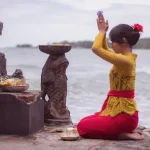


Complete Guide to Kramaning Sembah Mantras: The Order of Panca Sembah and Their Meanings
Performing a devout Kramaning Sembah requires a deep understanding of the meaning behind each mantra. This is essential so that every word spoken becomes a spiritual vibration that unites the soul with the Creator.
Preparation of Offerings (Purification of Flowers & Incense)
Before beginning the Panca Sembah, it is crucial to purify the tools and offerings to ensure the prayer is performed perfectly:
- Purifying the Incense (Dhipa Astra)“Om ang dhipa astra ya namah swaha.”Meaning: O Lord, sharpen the light of this incense so that it may become a purification for me.
- Purifying the Flowers (Puspam)“Om puspa danta ya namah swaha.”Meaning: O Lord, may these flowers become as pure as Your divine essence.
The Sequence of Panca Sembah Mantras
1. First Sembah: Sembah Puyung (Empty Hands)
Dedicated to Ida Sang Hyang Widhi Wasa in His form as Parama Siwa (The Soul of the entire universe).
“Om atma tattwatma suddha mam swaha.”
Meaning: O Lord, You are the Atman (soul) of all that exists; please purify my soul.
2. Second Sembah: Worship of Sang Hyang Aditya
Using a flower (preferably white or yellow), dedicated to Sang Hyang Surya/Aditya as the divine witness of the world.
“Om adityasya param jyoti, rakta teja namo’stute, sweta pankaja madhyastha, bhaskaraya namo’stute.”
Meaning: O Lord, I worship You who are the supreme light of Sang Hyang Aditya; I worship You who reside in the heart of the white lotus; You are the source of all radiance.
3. Third Sembah: Worship of Ista Dewata
Using a Kwangen or a combination of colorful flowers. Dedicated to the Ista Dewata (the specific manifestation of God) residing at the place of worship.
“Om nama dewa adhisthanaya, sarwa wyapi wai siwaya, padmasana ekapratisthaya, ardhanareswaraya namo namah.”
Meaning: O Lord, I worship You who reside in this sacred place; the All-Pervasive Lord (Siwa) who dwells upon the lotus throne, as the inseparable embodiment of masculine and feminine divine powers.
4. Fourth Sembah: Seeking Divine Grace
Using flowers or a Kwangen, dedicated to seeking blessings and grace from Ida Sang Hyang Widhi.
“Om anugraha manoharam, dewa datta nugrahakam, arcanam sarwa pujanam, namah sarwa nugrahakam. Om dewa-dewi mahasiddhi, yajnya nirmala atmaka, laksmi siddhisca dirghayur, nirwighna sukha wrddhisca.”
Meaning: O Lord, grant us joy, for You are the Giver of Grace. May we be blessed with happiness, prosperity, longevity, and freedom from all obstacles.
5. Fifth Sembah: Sembah Puyung (Closing)
Empty hands without flowers to conclude the Panca Sembah sequence.
“Om dewa suksma parama acintyaya namah swaha. Om Santih, Santih, Santih Om.”
Meaning: O Lord, I worship You in the form of Parama Acintya, the Unfathomable and Divine Creator. May there be peace, peace in the heart, peace in the world, peace forever.

Summary Table of Kramaning Sembah
| Sequence | Medium | Object of Worship |
| Sembah 1 | Empty Hands | Purification of Atman (God as the Soul) |
| Sembah 2 | Flower | Sang Hyang Aditya (Divine Witness) |
| Sembah 3 | Kwangen/Flower | Ista Dewata (God at the sacred site) |
| Sembah 4 | Kwangen/Flower | Seeking Grace & Peace |
| Sembah 5 | Empty Hands | Gratitude & Conclusion (Parama Acintya) |
After Panca Sembah: Receiving Tirta and Bija
After completing the Panca Sembah, the next vital step is receiving Tirta (Holy Water) and Bija (Holy Seeds/Rice). Tirta serves as an inner and outer purification, while Bija symbolizes the seeds of goodness and prosperity planted within oneself.
Mantra for Receiving Tirta:
When sprinkling or drinking the Tirta, recite this mantra so the water truly becomes Amerta (the nectar of life):
“Om pratama suddha, dwitya suddha, tritya suddha, caturty suddha. Om suddha, suddha, suddha waryastu swaha.”
Meaning: O Lord, the first purification, the second, the third, and the fourth. O Lord, may this water become a perfect cleanser for me.
How to Use Tirta:
- Sprinkled on the head 3 times (for purification of thoughts).
- Sipped 3 times (for purification of speech).
- Wiped over the face/body 3 times (for purification of actions).
Conclusion
The performance of Kramaning Sembah, concluded with receiving Tirta, constitutes a complete act of worship in the Hindu tradition. By understanding each mantra and its meaning, our prayer is no longer just a physical movement, but a profound spiritual dialogue to achieve self-purity.
May this guide help you perform your worship with greater devotion and conviction. Let us maintain the purity of heart and mind so that every step we take is blessed by Ida Sang Hyang Widhi Wasa. Om Santih, Santih, Santih Om.
Deepening the Sacred Syllable “Om”
In every verse of the Kramaning Sembah mantras, we always begin with the sacred syllable “Om”. This syllable is not merely a sound; it is a primordial symbol representing the entire universe and the presence of Ida Sang Hyang Widhi Wasa in every aspect of life.
To deepen your spiritual understanding of why this syllable is so sacred, please read our in-depth article here: The Meaning and Philosophy of the Sacred Symbol Om in the Vedas.